There is something pretty special about watching older students work with younger students.
You can almost see the dynamic change.
The older students suddenly seem a little taller, a little more responsible, and a whole lot more interested in being a good example. The younger students often look at their older buddies with a mixture of excitement and admiration.
And when you put them together with a little structure and a fun activity, some really wonderful things can happen.
Older students have an opportunity to practice leadership, patience, communication, and kindness. Younger students get a chance to learn from someone they admire, ask questions, and experience what it feels like to be included by an older student.
Of course, there’s one little problem.
Sometimes you put two students together and…
Crickets.
They look at each other.
Nobody says anything.
The older student doesn’t know what to ask, and the younger student isn’t quite sure what to say.
That’s why I think having a few simple activities ready to go can make such a difference.

Big Buddies and Little Buddies Can Be Pretty Special
There is something about being paired with an older student that can make a younger child feel important.
Suddenly, they have someone to look up to. Someone who can show them how things work. Someone who can answer questions, listen to their ideas, and make school feel a little more exciting.
And the older students often rise to the occasion.
They may start out acting like it’s no big deal, but once they realize a younger student is looking up to them, you may see a completely different side of them.
They become more patient.
They explain things.
They encourage.
They help.
They listen.
Sometimes you see leadership skills come out of students who don’t always have many opportunities to show them in the regular classroom.
That’s one of the reasons I love buddy activities so much.
They’re good for the little kids, but they’re also really good for the big kids.

Younger Students Love Having Someone to Look Up To
Think about how younger students often talk about older kids.
They’re fascinating!
Older students can seem so grown-up when you’re in elementary school. They know how to do things you haven’t learned yet, they seem confident walking through the school, and they have stories and experiences that younger students find interesting.
When younger students get to spend time with older buddies, they have an opportunity to see what comes next.
They might hear about activities the older students enjoy, see how they approach a project, or simply get a glimpse of what it’s like to be one of the “big kids.”
That relationship can give younger students something to work toward.
They may start thinking, “When I’m that age, I want to be able to do that, too.”
And there’s something really positive about that.
Instead of simply telling younger students what good behavior, kindness, leadership, or responsibility looks like, they get to see it in action.
Older Students Have an Opportunity to Be Role Models
Of course, the benefits go both ways.
Older students are often given plenty of opportunities to demonstrate what they know academically, but working with younger students gives them a different kind of challenge.
They have to think about how they’re communicating.
They have to be patient when someone doesn’t understand something right away.
They have to listen instead of always being the person who talks.
And sometimes they have to figure out how to make someone else feel comfortable.
Those are important skills.
An older student may not think of themselves as a leader when they’re sitting in their regular classroom. But put a younger student beside them, and suddenly they have someone watching what they do.
That’s a pretty powerful opportunity.
It can be amazing to see a student who might be quiet or reserved with their peers become confident and encouraging when they’re working with a younger child.
Sometimes kids just need the right opportunity to show what they’re capable of.

But Let’s Be Honest… It Can Be Awkward!
Here’s the part we sometimes forget.
Just because two students are sitting together doesn’t mean they’ll automatically know what to say.
You can announce, “Okay, find your buddy and get to know each other!” and then walk away expecting a beautiful friendship to magically appear.
And instead…
They’re staring at each other.
One student says, “Hi.”
The other says, “Hi.”
And then they both look at you.
We’ve all been there!
That’s why I think having an activity ready is so helpful.
Instead of asking students to figure out how to start a conversation from scratch, give them something to do together.
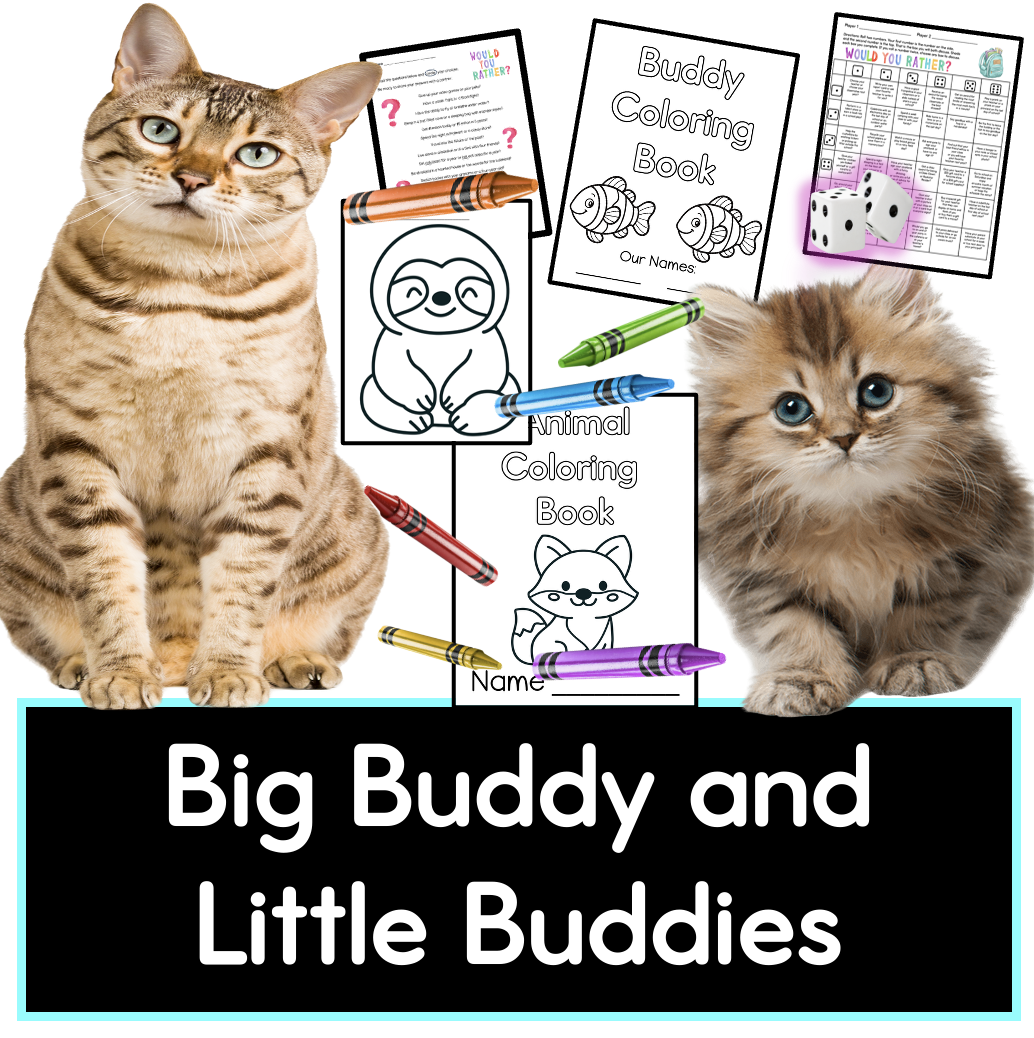
A coloring sheet.
A simple game.
A partner activity.
A Would You Rather question.
A team-building challenge.
A craft.
An icebreaker.
Now they have a reason to talk.
And once the conversation gets started, the rest often becomes much easier.

Give Them Something to Talk About
Imagine pairing an older and younger student together and simply saying, “Get to know each other.”
That’s a pretty big request!
What should they ask?
What if they don’t have anything in common?
What if one student is shy?
What if the older student doesn’t know how to start the conversation?
A structured activity takes away some of that pressure.
For example, a simple Would You Rather question gives both students an immediate topic.
“Would you rather have a pet dinosaur or a pet dragon?”
Now they have an answer.
They can explain their choice.
They can laugh at each other’s answers.
They can ask, “Why?”
And suddenly, they’re talking.
The activity doesn’t have to be complicated. In fact, I think simple is usually better.
The goal isn’t to keep students busy every second. The goal is to create an easy opening for conversation and connection.

Activities Can Make Buddy Time More Meaningful
Having an activity ready also gives students something they can work on together.
A coloring activity gives them something to sit beside each other and complete.
A game gives them a shared experience.
A partner activity gives them a reason to take turns and communicate.
A team-building activity gives them a chance to solve something together.
These experiences can help students move beyond simply sitting next to each other.
They’re actually doing something together.
And that’s where some of the best social learning happens.
Students have to listen.
They have to take turns.
They may need to explain an idea.
They might disagree.
They might encourage one another.
They might laugh when something doesn’t go as planned.
Those are all little opportunities to practice working with other people.
Learning to Work With Different People Is a Big Skill
One of the wonderful things about buddy programs is that students don’t always get to choose who they work with.
And while choosing our own friends is fun, learning how to work with different kinds of people is an important skill, too.
Students will eventually work with classmates, teammates, coworkers, neighbors, and people they don’t automatically connect with.
School gives us a safe place to practice.
When students work with someone who is younger or older, they have to adjust how they communicate.
They may need to explain something differently.
They may need to slow down.
They may need to listen more carefully.
They may discover that they actually enjoy working with someone they wouldn’t have chosen themselves.
Those are valuable experiences.
And the more opportunities students have to practice them, the more comfortable they can become.
The Small Moments Can Be the Most Meaningful
Sometimes we look at a buddy activity and think the goal is simply to give students something fun to do.
But there can be so much more happening underneath it.
An older student might discover that they’re actually a pretty good leader.
A younger student might find a new person they admire.
A shy student might find it easier to talk when they have a game to play.
Two students might discover that they have something surprisingly important in common.
And sometimes a few minutes spent coloring, playing a game, or answering silly questions can be the beginning of a relationship that continues long after the activity is over.
We don’t always know which moments will stick with students.
That’s part of the fun.
Keep a Few Buddy Activities Ready to Go
If your school has a big buddy/little buddy program, I’d definitely recommend keeping a small collection of easy activities available.
You don’t need a huge binder full of complicated projects.
A few reliable activities can go a long way.
Think about things that are easy to explain and don’t require a lot of materials. Coloring pages, conversation starters, partner games, Would You Rather activities, and simple team-building challenges can all give students something to do while naturally encouraging conversation.
The key is to make it easy for students to get started.
Because sometimes the hardest part isn’t getting students to connect.
It’s getting them past that first awkward “Hi.”
Once they have something to talk about, you may be surprised by what happens next.
The older student starts asking questions.
The younger student starts sharing.
They discover something they have in common.
They laugh.
They work together.
And before you know it, that awkward silence is gone.
That’s the power of pairing students together.
We’re not just giving kids something to do.
We’re giving them opportunities to practice communication, kindness, leadership, patience, cooperation, and friendship.
And sometimes, when we give kids the right opportunity, the very best parts of them come out.
Happy teaching! 💜
Katie